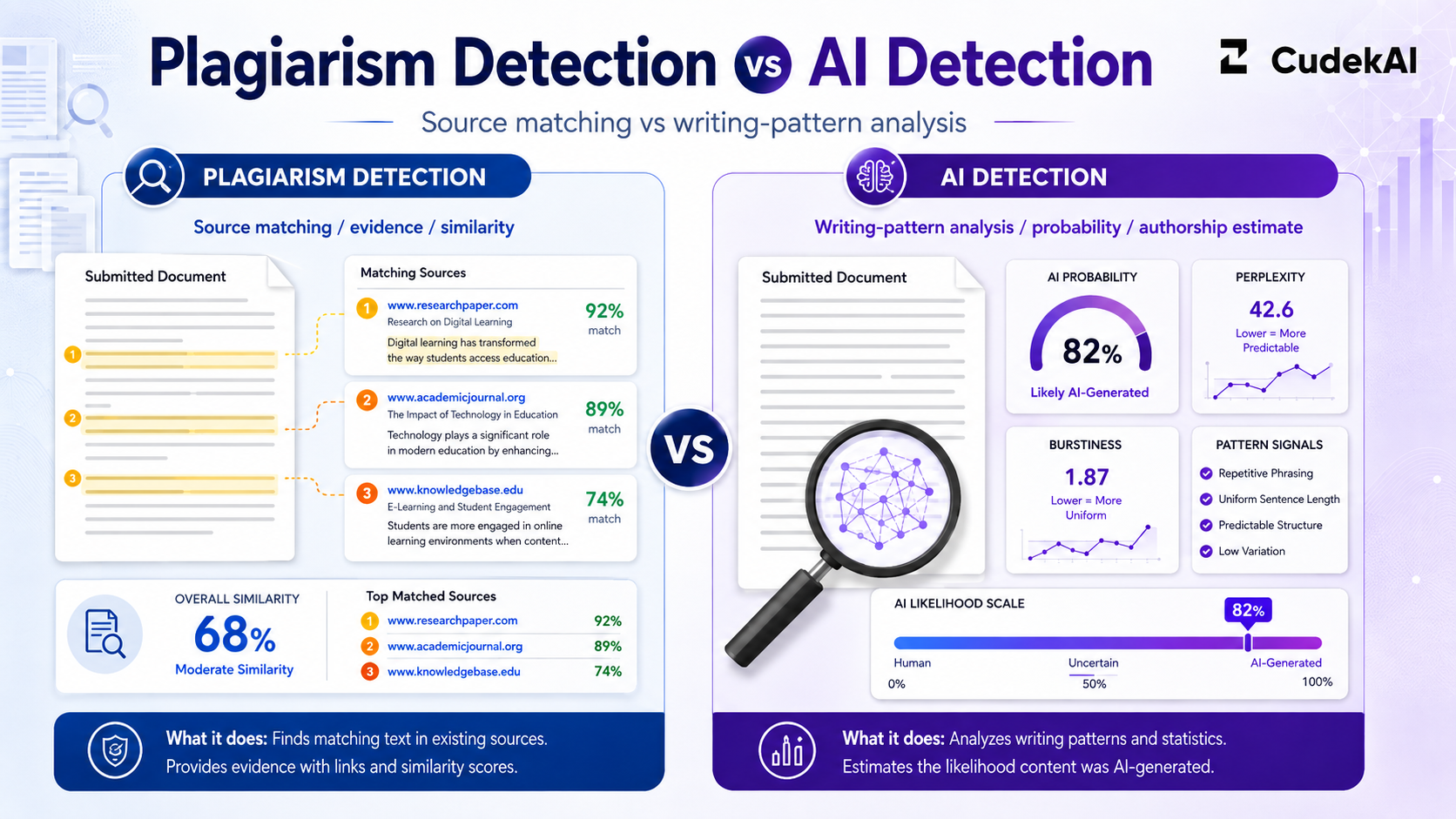
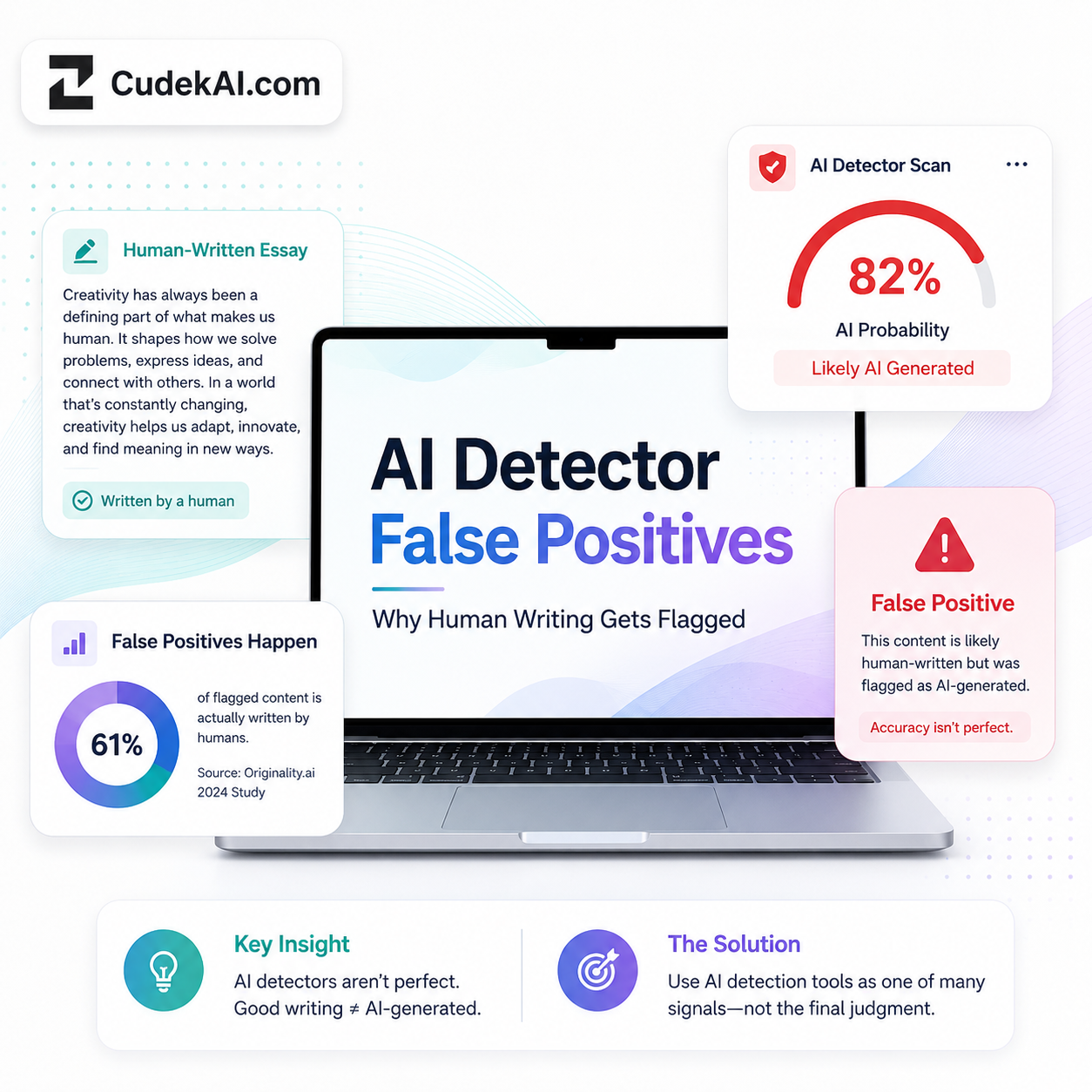
ChatGPT generates grammatically correct content within seconds but produces distinctive robotic patterns readers instantly recognize, diminishing credibility and engagement. Writers, marketers, students, and professionals relying on ChatGPT face AI detection risks, audience distrust, and content rejection when publishing unmodified output exhibiting mechanical transitions, uniform sentences, and impersonal tone. Humanizing ChatGPT transforms algorithmic drafts into authentic prose exhibiting natural rhythm, conversational flow, emotional resonance, and personal voice while preserving factual accuracy and original meaning.
CudekAI AI Humanizer converts robotic ChatGPT output into natural human writing through advanced algorithms analyzing sentence patterns, vocabulary repetition, transition phrases, and tonal uniformity. The text humanization tool restructures mechanical phrasing into authentic expressions, bypassing AI detection platforms while enhancing readability and audience connection.
What Makes ChatGPT Writing Sound Robotic?
ChatGPT writing often looks polished but contains repeating patterns that make it feel unnatural and easy to detect. Understanding these patterns enables effective humanization, addressing specific weaknesses rather than applying generic rewriting.
Excessive Use of Transition Phrases
Excessive transition phrases represent ChatGPT’s most recognizable pattern, where mechanical connectors appear with unnatural frequency. The model defaults to formulaic transitions, including “furthermore,” “moreover,” “in addition,” “consequently,” “therefore,” “it is worth noting,” and “in conclusion” appearing multiple times per article. Human writers employ diverse bridging strategies, varying transitional language while maintaining logical flow through contextual connections rather than mechanical signals.
Overuse of em dashes
Overuse of em dashes creates distinctive ChatGPT formatting where dashes appear excessively throughout text, separating clauses, introducing examples, and marking parenthetical information. While em dashes serve legitimate stylistic purposes in human writing, ChatGPT employs them disproportionately, creating visual patterns associated with AI generation. Natural writing varies punctuation using commas, semicolons, colons, and periods strategically rather than defaulting to dashes.
Generic Buzzwords and Vague Language
ChatGPT tends to use corporate-style vocabulary terms, including “leverage,” “utilize,” “facilitate,” “implement,” “optimize,” “streamline,” “robust,” “comprehensive,” “innovative,” and “cutting-edge” creating business-speak-sounding artificial rather than authentic. Human experts use specific technical terminology appropriate to fields while avoiding vague corporate language.
Uniform Sentence Length and Structure
Uniform medium-length sentences create a monotonous rhythm where consecutive sentences maintain similar word counts and grammatical structures. ChatGPT defaults to complex sentences averaging 15-25 words, combining independent and dependent clauses through predictable patterns. Human writing exhibits dramatic length variation, mixing short impactful statements with longer analytical explanations and medium narrative sentences, creating dynamic reading experiences.
Excessive Hedging and Qualification
Hedging language and excessive qualification weaken ChatGPT assertions, where phrases like “it is important to note,” “one might consider,” “it could be argued,” and “it is worth mentioning” appear frequently. While appropriate hedging demonstrates intellectual humility, excessive qualification creates a wishy-washy tone lacking confidence. Expert human writers make direct claims supported by evidence, avoiding unnecessary hedging, undermining authority.
Why Should Writers Humanize ChatGPT Output?
Writers should humanize AI to understand the risks of using unrefined AI-generated text for multi-purpose content:
AI Detection Systems Flag Robotic Content
Educational institutions, publishers, content platforms, and employers deploy AI detection software analyzing linguistic patterns, identifying ChatGPT-generated content. Detection algorithms trained on ChatGPT output recognize transition phrase frequency, sentence uniformity, vocabulary patterns, and stylistic markers distinguishing machines from human writing. Content flagged as AI-generated faces rejection, penalties, or credibility damage regardless of factual accuracy.
Students submitting ChatGPT-written assignments risk academic integrity violations, failing grades, and disciplinary action. Understandinghow to humanize AI content for academic writing becomes essential for students who want to use AI ethically while avoiding detection penalties. Professional writers publishing unmodified ChatGPT content face editorial rejection and reputation damage. Marketers using ChatGPT copy encounter spam filters and audience distrust. Job applicants submitting ChatGPT-written materials receive automatic rejection from AI-screening systems. Humanization transforms detectable patterns into natural writing, passing both automated detection and human evaluation.
Readers Recognize and Reject Artificial Content
Audiences instinctively identify ChatGPT writing through tone flatness, personality absence, and mechanical phrasing, even without technical expertise. Generic language, predictable structure, and impersonal delivery create psychological distance, reducing engagement, persuasion effectiveness, and message retention. Readers perceive robotic content as lower quality regardless of information accuracy, undermining the author’s credibility.
Marketing content requiring emotional connection and persuasive appeal particularly suffers from ChatGPT limitations. Sales copy, brand storytelling, and customer communication demand authentic voice, relatable messaging, and empathetic understanding that pure algorithmic generation cannot replicate. Blog content and social media posts need personality, conversational accessibility, and a human perspective, distinguishing brands from competitors using identical AI tools.
Search Engines Prioritize Human-Quality Content
Search engines emphasize content demonstrating expertise, authoritativeness, and trustworthiness, with human authorship signals contributing to quality assessments. While ChatGPT content isn’t explicitly penalized, robotic writing exhibiting thin value, repetitive phrasing, and a lack of original perspective receives lower rankings. Humanization improves content quality through enhanced readability, unique insights, and natural language patterns supporting SEO performance.
Google’s helpful content guidelines prioritize people-first content created for humans rather than search engine manipulation. ChatGPT output optimized for keyword density and algorithm signals without a human perspective contradicts these principles. Humanized ChatGPT text balances search visibility with genuine reader value, creating content serving both ranking and engagement objectives.
What Specific ChatGPT Patterns Need Humanization?
The following are the AI-generated terms and phrases that need to be replaced with natural human expression:

Replace Mechanical Transition Phrases
ChatGPT defaults to formulaic transitions, creating a predictable flow that readers recognize as artificial. Replace “furthermore” with contextual bridges like “this approach also,” “the same principle,” or “building on this foundation.” Substitute “moreover” with “beyond that,” “equally important,” or specific references to previous points. Eliminate “in addition” in favor of “alongside these benefits,” “complementing this strategy,” or natural continuations.
Transform “consequently” into specific causal language: “this creates,” “the result is,” or “because of this.” Replace “therefore” with “so,” “that’s why,” or direct conclusions without transition markers. Eliminate “it is worth noting” in favor of direct statements: “notably,” “importantly,” or “keep in mind.” Remove “in conclusion” preferring natural endings or simple “ultimately.”
Organic transitions emerge from conceptual relationships, creating seamless flow without mechanical signals. Reference previous sentences using pronouns and demonstratives: “this challenge,” “these findings,” “such considerations.” Employ parallel structures echoing earlier phrasing, creating rhythmic connections. Use transitional adverbs sparingly: “meanwhile,” “alternatively,” “nevertheless” varying placement and frequency.
Remove Excessive Em Dashes and Format Variations
ChatGPT inserts em dashes excessively, interrupting the flow and creating distinctive visual patterns. Audit drafts identifying every dash, evaluating whether commas, parentheses, semicolons, or sentence restructuring improves readability. Limit dashes to 1-2 per paragraph maximum, reserving them for dramatic emphasis or significant parenthetical information.
Replace “The solution—advanced AI tools—transforms writing” with “Advanced AI tools transform writing.” Substitute “Content requires three elements—clarity, engagement, and value” with “Content requires clarity, engagement, and value.” Convert “Marketing drives results—when executed properly” to “Marketing drives results when executed properly.”
Vary punctuation strategically using commas for standard separation, semicolons connecting independent clauses, colons introducing lists or explanations, and periods creating definitive breaks. This diversity prevents monotonous visual patterns while improving readability through appropriate grammatical construction.
Eliminate Generic Buzzwords and Corporate Jargon
ChatGPT overuses impressive-sounding terms lacking specific meaning, creating vague business-speak. Replace “leverage” with concrete verbs: “use,” “apply,” “employ,” or specific actions. Substitute “utilize” with ” simple use.” Convert “facilitate” to “enable,” “help,” or “make possible.” Transform “implement” into “start,” “adopt,” or “introduce.”
Eliminate “robust” describing tools or solutions with specific capabilities: “comprehensive features,” “handles 10,000 requests,” or “processes multiple formats.” Replace “streamline” with measurable improvements: “reduces steps from seven to three,” “cuts processing time 40%,” or “eliminates manual approval.” Convert “innovative” to specific novelty: “first platform supporting,” “introduces unique,” or “pioneering approach.”
Specific language replaces vague terms with concrete descriptions, measurable outcomes, and tangible examples. Instead of “optimize performance,” specify “increase loading speed 2.3 seconds” or “reduce memory usage 35%.” Rather than “comprehensive solution,” detail “covers all five compliance requirements” or “includes 47 pre-built templates.”
Vary Sentence Lengths Dramatically
ChatGPT produces uniform medium-length sentences, creating a monotonous rhythm. Introduce dramatic variation by mixing short punchy statements with longer analytical explanations. Short sentences emphasize key points. They create impact. They focus their attention. Longer sentences develop complex ideas connecting multiple concepts through subordinate clauses and descriptive details while maintaining logical flow and readability. Medium sentences maintain a steady narrative pace during explanation and analysis.
Open paragraphs with short attention-grabbing statements establishing main points. Develop ideas through longer explanatory sentences providing context, evidence, and analysis. Conclude paragraphs with medium summary sentences or short memorable takeaways. This rhythm creates engaging reading experiences, preventing monotony while enhancing comprehension through varied information density.
Structural diversity extends beyond length, encompassing grammatical constructions. Mix simple sentences stating direct claims, complex sentences combining clauses, compound sentences connecting ideas, periodic sentences building suspense, and cumulative sentences adding or modifying details. Include rhetorical questions engaging readers directly and occasional fragments for dramatic emphasis.
Inject Personal Voice and Conversational Elements
ChatGPT produces an impersonal, objective tone lacking human perspective and emotional engagement. Inject voice through perspective markers, evaluative language, and conversational asides. First-person references are appropriate for personal essays, thought leadership, and informal content: “I’ve observed,” “my experience shows,” “I find.” Second-person address creates involvement: “you’ll notice,” “consider how,” “imagine.”
Evaluative expressions indicate human judgment beyond information presentation: “notably,” “surprisingly,” “unfortunately,” “encouragingly,” “remarkably.” Qualifying language acknowledging complexity: “while generally effective,” “under most conditions,” “with important exceptions.” Rhetorical questions invite reflection: “What drives this trend?” “Why does this matter?” “How does this work?”
Conversational asides inject personality through parenthetical comments, informal expressions, and colloquial language. Include brief stories, specific examples, and real-world scenarios illustrating abstract concepts. Reference shared experiences and common knowledge, connecting with readers through familiar situations. These elements transform information delivery into engaging communication reflecting human consciousness.
How Can You Humanize ChatGPT Through Prompting?
Humanize ChatGPT output starts with writing better prompts that guide tone, structure, and style from the beginning by following these methods:
Specify Writing Style and Tone Requirements
Effective prompts guide ChatGPT toward human-like output by explicitly defining style parameters. Direct the model to “write conversationally like explaining to a friend” or “adopt a professional but approachable tone.” Specify “avoid business jargon and corporate buzzwords” or “use concrete examples rather than abstract concepts.”
Include style instructions within prompts: “Write in varied sentence lengths, mixing short impactful statements with longer explanations. Avoid transition words like furthermore, moreover, and in addition. Skip em dashes using commas instead. Replace generic terms with specific language.” These explicit constraints prevent default robotic patterns.
Provide target audience specifications guiding appropriate formality and complexity: “Write for experienced marketers familiar with analytics terminology” or “Explain concepts for complete beginners without a technical background.” Audience definitions help ChatGPT calibrate vocabulary, explanation depth, and example selection.
Provide a writing sample for Style Matching
Upload representative human-written samples, directing ChatGPT to analyze and emulate style characteristics. “Analyze this writing sample, identifying tone, sentence structures, vocabulary patterns, and stylistic elements. Write new content matching this style.” Sample-based prompting produces output more closely resembling human writing than generic instructions.
Combine sample analysis with specific content requests: “Based on the writing style in this sample, create an article about topic X, maintaining the same tone, sentence variation, and vocabulary choices.” This approach transfers an authentic human voice into new content areas.
Multi-shot prompting provides several examples demonstrating desired output characteristics. Show 2-3 examples of acceptable human-like writing, followed by content requests. Pattern recognition from multiple examples produces more consistent human-like generation than single instructions.
Implement Custom Instructions for Consistent Humanization
Configure ChatGPT custom instructions, establishing permanent style guidelines applying across conversations. Navigate Settings → Personalization → Custom Instructions, adding: “Write like a human. Keep professional but conversational. Avoid em dashes and buzzwords like streamline, leverage, and robust. It sounds clear and natural, like writing to a smart colleague. Vary sentence lengths dramatically. Skip mechanical transitions.”
Custom instructions eliminate the need for repeated style specifications in individual prompts. Every ChatGPT response automatically incorporates humanization guidelines, producing more natural initial output requiring less manual editing. Refine custom instructions iteratively based on output quality, adjusting constraints as needed.
Combine custom instructions with prompt-specific requirements for maximum control. General instructions establish baseline style while individual prompts add content-specific parameters, producing optimal results, balancing automation efficiency with output quality.
How Does CudekAI Humanize ChatGPT Effectively?
CudekAI humanizes ChatGPT outputs by using structured linguistic analysis and rewriting systems for a humanized version:

Pattern Recognition Trained on ChatGPT Output
CudekAI ChatGPT Humanizer employs machine learning models trained specifically on ChatGPT-generated text, identifying distinctive patterns requiring transformation. Training datasets encompass millions of ChatGPT outputs across topics, formats, and prompt types, providing a comprehensive understanding of characteristic weaknesses. Pattern recognition algorithms detect transition phrase frequency, sentence uniformity, em dash overuse, buzzword density, and other telltale markers.
Analysis processes examine multiple linguistic dimensions simultaneously. Transition detection identifies mechanical phrases requiring replacement with organic bridges. Sentence structure evaluation measures length uniformity and grammatical repetition. Vocabulary assessment flags generic buzzwords, corporate jargon, and hedging language. Punctuation analysis locates excessive em dashes, formatting patterns, and style monotony.
Color-coded highlighting indicates sections requiring attention with red marking severe robotic patterns demanding immediate revision and yellow suggesting improvement opportunities. Similarity scoring quantifies overall machine-like quality, guiding revision priorities and transformation intensity. Writers wanting to verify their humanized output across multiple platforms can review our comparison of CudekAI vs GPTZero — which AI-generated detector is best for cross-platform verification insights.
Context-Preserving Restructuring Engine
Unlike basic paraphrasing substituting synonyms without understanding meaning, CudekAI maintains semantic accuracy while transforming expression patterns. Context analysis ensures revised content preserves original information, logical relationships, and argumentative structure while varying vocabulary, sentence construction, and stylistic elements. This sophisticated approach prevents meaning distortion common in simple rewriting tools.
Restructuring strategies adapt to content types. Professional business content maintains a formal register and authoritative tone while eliminating corporate jargon and mechanical patterns. Marketing copy introduces persuasive elements, emotional appeal, and conversational accessibility. Blog content emphasizes personality, storytelling, and relatable examples. Academic writing preserves scholarly conventions while varying expression and removing robotic patterns.
Multi-pass refinement progressively naturalizes text through iterative transformations. Initial passes remove obvious mechanical elements like transition phrases and em dashes. Subsequent iterations vary sentence structures, replace generic vocabulary, and inject subtle voice markers. Final passes optimize flow, coherence, and overall readability.
Tone Customization for Different Contexts
CudekAI offers adjustable tone settings, adapting humanization approaches to specific audiences and purposes. Professional mode maintains business-appropriate formality while introducing natural variation, concrete language, and subtle personality. Conversational mode increases accessibility through informal expressions, contractions, direct address, and relaxed structure. Academic mode preserves scholarly register while eliminating robotic patterns and enhancing readability.
Creative mode emphasizes personality, stylistic flourishes, emotional resonance, and storytelling elements appropriate for blogs, social media, and brand content. Technical mode maintains specialized terminology and precision while varying expression patterns and removing jargon. Each tone setting applies appropriate transformation strategies matching context requirements.
Intensity controls adjust transformation depth from light edits, preserving more original phrasing to comprehensive restructuring, creating maximally natural output. Users select transformation levels balancing preservation of specific ChatGPT-generated insights with humanization completeness.
Processing Speed and Accessibility
CudekAI processes ChatGPT text, delivering humanized output within 8-12 seconds for typical article lengths. Fast processing enables rapid iteration, checking multiple transformation settings and refinement levels, identifying optimal results. Speed supports workflow integration, allowing writers using ChatGPT for initial drafts to humanize content without productivity delays.
Free-trial access democratizes ChatGPT humanization technology for students, freelance writers, small business owners, and individual professionals. No subscription fees or usage limits prevent cost barriers restricting access to quality humanization tools. This accessibility ensures that anyone using ChatGPT can produce natural, human-like content regardless of financial circumstances.
The browser-based platform requires no software installation, operating directly through web interfaces on computers, tablets, and smartphones. Multiple file format support, including plain text, document files, and direct paste, accommodates different workflows and content management systems.
What Manual Editing Techniques Enhance ChatGPT Text?
Apply these manual techniques to enhance ChatGPT text more efficiently. Writers seeking deeper professional-level skill development should also review our How to Humanize AI Texts, which covers advanced editorial techniques used by professional writers and editors handling AI-assisted drafts.
Read Aloud for Natural Flow Detection
Reading ChatGPT output aloud reveals awkward phrasing, unnatural rhythm, and mechanical patterns difficult to identify through silent reading. Natural human speech exhibits varied cadence, strategic pauses, and emotional inflection impossible to reproduce through uniform algorithmic generation. Sections sounding stiff, repetitive, or uncomfortable when spoken require revision.
Pay attention to breathing patterns while reading. Sentences requiring breath mid-thought or preventing natural pausing indicate structural problems. Natural speech follows logical groupings, allowing comfortable phrasing. Awkward sentence breaks, excessive clause nesting, or run-on constructions preventing smooth vocalization need restructuring.
Listen for repetitive rhythm indicating uniform sentence structures. Natural speech varies dramatically in pacing, length, and emphasis. Monotonous rhythm signals mechanical generation requiring sentence restructuring for variation. Notice transition phrases sounding forced or unnatural in speech—these mechanical connectors need replacement with contextual bridges.
Add Specific Examples and Concrete Details
ChatGPT produces abstract generalizations lacking grounding in specific reality. Transform vague statements into concrete illustrations through detailed examples, specific numbers, named entities, and tangible scenarios. Replace “businesses benefit from data analysis” with “retail chains tracking purchase patterns reduced waste 23% while increasing revenue 15%.”
Include real-world case studies, anecdotes, and practical applications demonstrating concepts in action. Brief stories illustrating principles stick in memory more effectively than theoretical explanations. Technical explanations benefit from specific instantiations showing abstract ideas through concrete implementations.
Sensory details and vivid descriptions engage readers, creating immersive experiences beyond information delivery. Rather than “the product improved experience,” describe specific enhancements: “reduced checkout from seven steps to three, added one-click reordering, and introduced real-time delivery tracking with map visualization.”
Verify Factual Accuracy and Update Information
ChatGPT training data limitations create outdated information, factual errors, and confident misinformation requiring verification. Cross-reference claims against current authoritative sources confirming accuracy before publishing. Update statistics, examples, and references reflecting current rather than training-period information.
Check specific claims about products, companies, technologies, and events that may have changed since ChatGPT training cutoff. Verify technical specifications, pricing information, availability, and feature details against official sources. Confirm quoted language appears accurately rather than representing ChatGPT hallucinations or paraphrases presented as direct quotations.
Replace generic temporal references with specific current information. Convert “recently” to actual dates. Update “current trends” with the latest developments. Specify “as of [date]” when discussing data, regulations, or situations potentially changing over time.
Final Thoughts
Humanization transforms robotic output by eliminating mechanical transitions, removing excessive em dashes, replacing buzzwords, varying sentence structures, and injecting personal voice. For comprehensivetips on humanizing AI text, writers can combine multiple strategies for maximum authenticity. These refinements prevent AI detection, build reader trust, improve search performance, and enhance communication effectiveness.
CudekAI ChatGPT Humanizer automates transformation through pattern recognition trained on ChatGPT output, context-preserving restructuring, customizable tone settings, and rapid processing. Average transformation time under 10 seconds enables efficient workflow integration. Free limited access democratizes humanization technology for global users. Multi-format support accommodates diverse content creation workflows. Effective humanization combines automated tool assistance with human editorial judgment, ensuring meaning accuracy, appropriate tone, and authentic voice. Writers using CudekAI for initial transformation followed by focused manual refinement achieve optimal results, balancing technological efficiency with human expertise, maintaining content quality while accelerating production timelines.